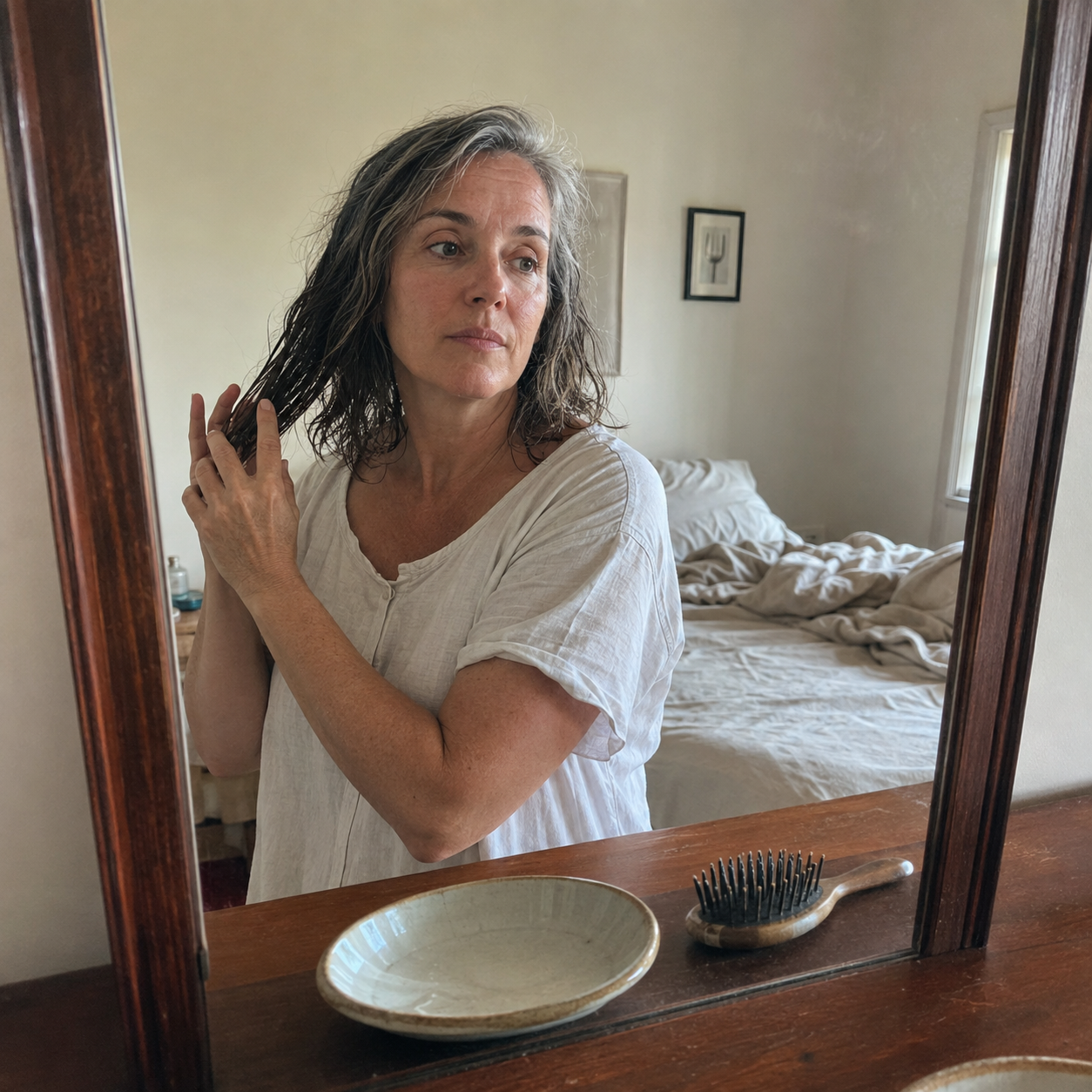
One silver hair stands upright at your part. Another makes a tiny corkscrew beside lengths that have always fallen straight. By noon, the soft gray at your temples has acquired opinions. If your hair seems to be changing one strand at a time, you aren't imagining the contrast.
You also don't need to declare every gray hair coarse. The research is more interesting than that, and much kinder to the person standing at the mirror with a brush in one hand.
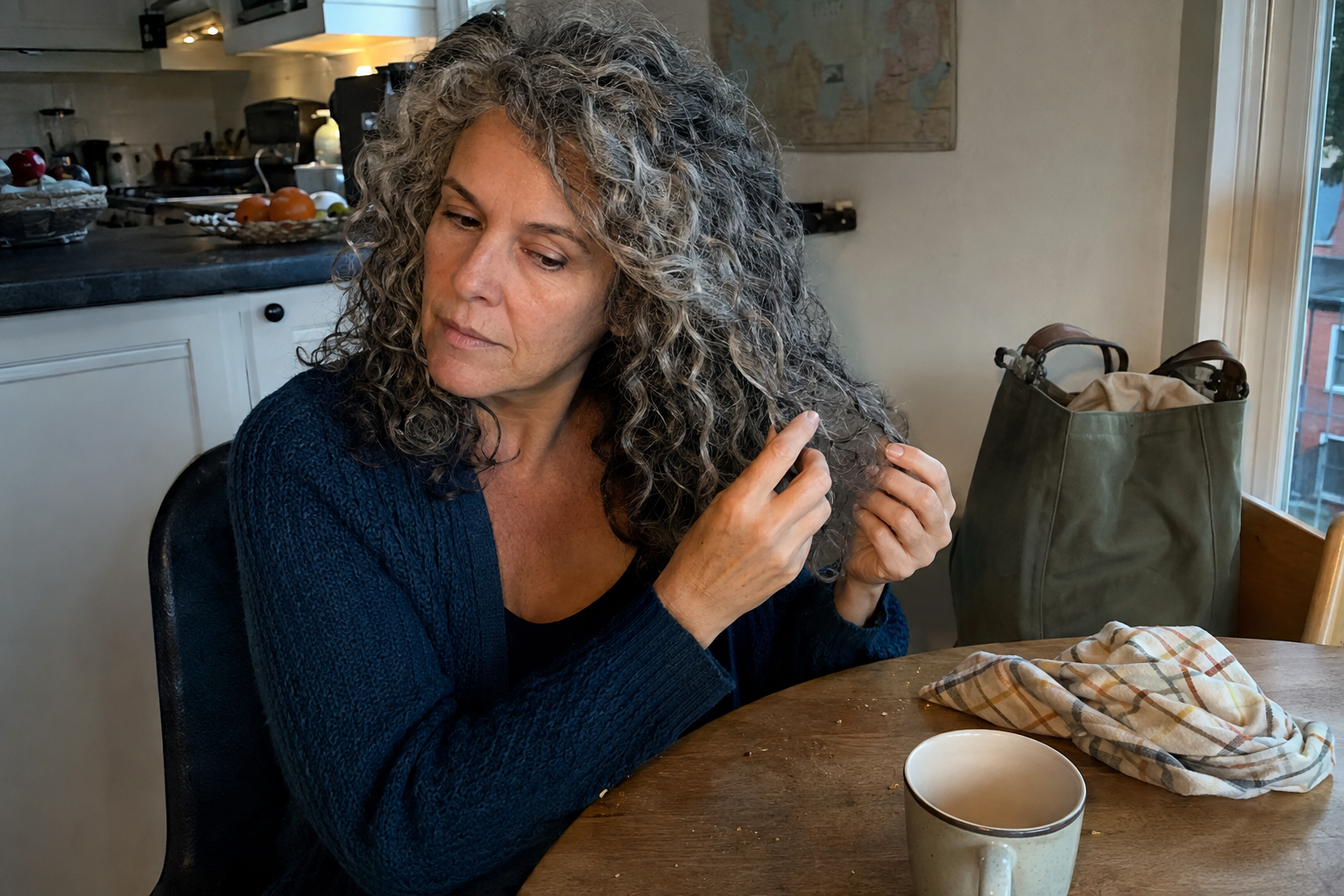
Silver doesn't come with one texture
A careful study of untreated, minimally sun-exposed salt-and-pepper hair found few sweeping differences between pigmented and unpigmented fibers across the whole group. Inside individual heads, though, the researchers often found small changes in mechanical behavior and in the way strands took up and released moisture. That helps explain why your new silver pieces may feel drier or less obedient while someone else's stay silky.
The important detail is the comparison happening on your own head. Pigment loss can arrive alongside changes in diameter, bend, and movement, but gray isn't a single hair type. Curl pattern, density, chemical color, heat styling, and the texture you started with still matter. Your fingers get the deciding vote.
A tiny change can make a visible fuss
Hair is mostly keratin, with lipids helping its structure and surface behave as a coherent fiber. Researchers examining graying strands with Raman microspectroscopy found gradual shifts in lipid and protein organization associated with barrier and biomechanical properties. It's a small laboratory window, based on 29 volunteers, rather than a verdict on every silver strand.
Small differences can still announce themselves. A wirier hair catches the light, lifts away from its neighbors, and changes the outline of a part or ponytail. Against darker hair, it is also easier to see. The silver strand that appears dramatically unruly may be physically different, visually conspicuous, or both.
Condition where the hair asks for it
Start with slip. Use your usual rinse-out conditioner, then work a small amount of leave-in through damp mid-lengths and ends. The American Academy of Dermatology recommends damp application because it helps distribute the product evenly; it also advises choosing the weight for your texture. Fine, straight silver hair may want a mist. Dense curls may welcome a cream.
Keep the first application modest and add only where your fingers meet resistance. A little extra on a bristly temple section makes more sense than coating the whole head by habit. Leave-in belongs on the hair rather than the scalp, where buildup can turn a good wash day dull and itchy.
Let the odd strand keep some character
Once there is slip, detangle gently from the ends upward and use the tool your texture likes. Then pause before reaching for another layer of oil or a hotter iron. If the hair feels soft yet still arcs away from the part, you're looking at shape, not a moisture emergency. A touch of styling cream on that one section is enough.
Gray hair doesn't need to be disciplined into perfect agreement with its neighbors. It needs observation. Notice whether the change is roughness, spring, dryness, or simply greater contrast, and answer that specific thing. The result still looks like your hair, only calmer where you wanted calm and beautifully silver everywhere else.